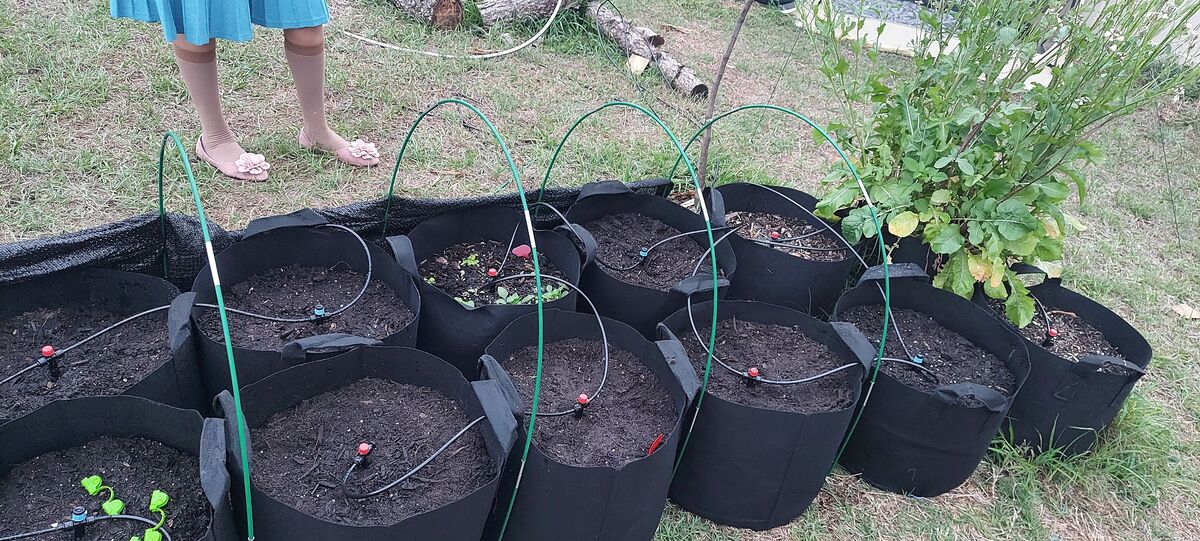
How to Water Grow Bags in Florida Heat (Set It and Forget It)
Water your grow bags once a day in Florida summer. Twice if they are in full sun and temps hit 95°F+. Or skip the daily routine entirely with a solar-powered drip system that costs about $110 and runs itself.
That is the short answer. The rest of this guide covers why grow bags dry out faster than you expect, what a seasonal watering schedule actually looks like in Zone 9b, and how to set up automation so you never think about watering again.
This article contains affiliate links. If you buy through our links, we may earn a small commission at no extra cost to you.
Why Grow Bags Dry Out Faster Than Regular Pots
Grow bags are made from breathable fabric. That is their biggest advantage — roots get air-pruned instead of circling, and soil stays cooler. But the trade-off is evaporation.
In a plastic pot, water only escapes from the top. In a grow bag, it evaporates from every surface. On a 95°F Florida afternoon with 80% humidity, a 10-gallon grow bag can lose moisture twice as fast as a same-size plastic container.
Add Myakka sand-based soil (common in North Port) and you have a growing medium that drains like a sieve. Water goes in, water goes out.
This is not a design flaw — it is a feature that prevents root rot, which kills more Florida container gardens than underwatering ever will. You just need to match your watering to the bag's behavior.
If you are still choosing bags, we recommend 10-gallon fabric grow bags — they hold moisture longer than smaller bags and give roots room to spread. See our best grow bags for Florida heat guide for specific picks.
vinmoso 10-Gallon Grow Bags 10-Pack
Our top pick for Florida. 300GSM fabric, reinforced handles, lasts 3–5 seasons in full sun. The 10-gallon size is the sweet spot — holds enough soil moisture to survive a missed watering day.
Check price on Amazon (paid link)The Florida Grow Bag Watering Schedule
Here is what works in Zone 9b, based on seasonal temps and typical grow bag sizes (7–15 gallon):
Summer (June–September)
- Frequency: Daily. Twice daily during heat waves (95°F+)
- When: Before 8 AM or after 6 PM. Never midday — water evaporates before roots absorb it
- How much: Until water runs out the bottom. For a 10-gallon bag, that is roughly 1–1.5 gallons per watering
- Watch for: Wilting by noon even after morning watering = needs a second round
Fall (October–November)
- Frequency: Every other day
- When: Morning preferred
- How much: Same — water until runoff
- Watch for: Afternoon storms may handle some days for you. Check soil before watering
Winter (December–February)
- Frequency: Every 2–3 days
- When: Late morning (let the chill burn off first)
- How much: Less than summer but still deep. Shallow watering encourages surface roots that die in the next heat wave
- Watch for: Frost nights — wet soil insulates roots better than dry
Spring (March–May)
- Frequency: Daily once temps consistently hit 85°F+. Every other day before that
- When: Morning
- How much: Full saturation
- Watch for: This is prime growing season. Underwatering here costs you your biggest harvest window
The Finger Test (30 Seconds, No Tools)
Push your finger 2 inches into the soil. If it feels dry, water. If it feels damp, wait.
This works but it means checking every bag every day. With 10+ bags, that is 10 minutes of poking dirt. There is a lazier way.
The Lazy Way: Solar Timer + Drip Kit
The entire point of lazy gardening is eliminating daily tasks. Here is the setup that does it:
Step 1: Drip irrigation kit. A basic kit with 1/4-inch tubing and drip emitters runs to each bag. One mainline, individual drip stakes per bag. Takes about 30 minutes to set up. See our full drip kit guide for specific product recommendations.
ANLEOLIFE 50FT Drip Irrigation Kit
Covers up to 30 containers. Includes tubing, drip stakes, connectors, and a pressure regulator. Pairs perfectly with a solar timer for a fully automated setup.
Check price on Amazon (paid link)Step 2: Solar water timer. This connects between your hose bib and the drip line. It runs on a solar panel — no batteries to swap, no outlet needed. Program it once and forget it.
Smart Solar Sprinkler Timer 2-Zone WiFi
Our top pick for lazy gardeners. Two zones, rain sensing, WiFi for schedule tweaks from your phone, and a solar panel that keeps it running indefinitely. About $68 — no batteries, no outlet, no maintenance.
Check price on Amazon (paid link)Check our solar timer comparison for the full breakdown of solar vs battery timers.
Step 3: Set the schedule.
- Summer: 15 minutes, twice daily (6 AM and 6 PM)
- Spring/Fall: 15 minutes, once daily (7 AM)
- Winter: 10 minutes, every other day (9 AM)
Adjust based on your specific setup. More emitters = less time needed per zone. Fewer emitters = longer run times.
Total one-time cost: About $110 (timer ~$68 + drip kit ~$40). After that, your water bill is the only ongoing cost — and drip irrigation uses 30–50% less water than hand-watering or sprinklers.
Three Mistakes That Kill Florida Grow Bag Plants
1. Watering at noon. The water hits hot soil, partially evaporates, and what remains can actually scald shallow roots. Always water early or late.
2. Shallow watering. A quick splash wets the top inch and trains roots to stay near the surface. When a 95°F day hits, those surface roots cook. Water deeply — until it drains from the bottom.
3. Ignoring winter watering. Florida winters are dry. Plants slow down but they do not stop drinking. More container plants die from winter drought than winter cold in Zone 9b.
Mulch: The Free Watering Upgrade
A 2-inch layer of mulch on top of your grow bag soil cuts evaporation by up to 50%. Use:
- Pine bark nuggets (cheap, available everywhere in Florida)
- Straw (breaks down and feeds the soil)
- Wood chips (longest lasting)
Skip rocks or gravel — they heat up in Florida sun and bake the soil underneath.
This single change can take you from twice-daily summer watering to once daily. If you are running a drip system, mulch means your 15-minute cycle actually saturates the root zone instead of losing half to evaporation.
Frequently Asked Questions
-
How often should I water grow bags in Florida summer?
Daily at minimum. In peak summer heat (95°F+), twice daily — morning and evening. Or automate it with a solar timer and drip system set to run twice per day.
-
Can you overwater a grow bag?
It is very difficult. The breathable fabric drains excess water naturally. Overwatering in grow bags is rare in Florida — underwatering is the real risk. The exception: if your grow bag is sitting in a saucer that holds standing water, dump it.
-
Do grow bags need more water than raised beds?
Yes. Raised beds retain moisture longer because they have more soil volume and less surface area exposed to air. Grow bags dry out 30–50% faster. This is the trade-off for better root health and portability. See our grow bags vs raised beds comparison for the full picture.
-
What is the best time to water grow bags in Florida?
Before 8 AM. Second-best: after 6 PM. Midday watering wastes water to evaporation and can stress plants through thermal shock.
-
Does the size of the grow bag affect watering frequency?
Yes. Smaller bags (3–5 gallon) dry out faster and may need twice-daily watering even in spring. Larger bags (10–15 gallon) hold moisture longer. We recommend 10-gallon bags as the sweet spot for Florida — see our best grow bags guide.
Bottom Line
Watering grow bags in Florida is not hard — it is just frequent. The fabric that makes grow bags great for root health also means they dry out fast in our heat.
You have two options:
- Manual: Check daily, water deeply, adjust seasonally. Works fine if you have 5 bags or fewer.
- Automated: Solar timer + drip kit. About $110 one-time, 30 minutes to set up, and you never think about watering again. This is what we recommend.
The lazy gardener's watering system is not about being cheap or cutting corners. It is about building a system that works without you — so your garden produces food whether you are home or on vacation.
Ready to set it up? Start with our drip irrigation kit guide and pair it with a solar water timer.